
Original German title: Selbstorganisierte Teams führen statt micromanagen
Co-facilitator: Christian Kolbe
Conference
May 15, 2024, Offenbach/Frankfurt
Copetri Convention (Cocon): People, Transformation, and Innovation
Abstract
People, Transformation, Innovation: These are the three cornerstones of COCON. Our self-organized teams work on all of these aspects through various initiatives and projects. But a word of caution: self-organization doesn’t mean we can stop thinking about leadership and project management. From the perspective of leaders who carry responsibility but are rarely involved in day-to-day operations, several questions arise:
How can we ensure that the right things are being worked on?
How do we guarantee the success of our projects?
How do we recognize, in a timely manner, exactly where we are needed?
And how do we manage all of this while still supporting the development of our employees?
Since our company was founded, we have been grappling with these exact questions and experimenting continuously to find the best possible framework. However, this workshop is about you.
Starting from the current status quo of all participants, we will evaluate, reflect on, and discuss various approaches and ideas in interactive small groups. Everyone will leave the session with at least one new impulse or idea to try out immediately—that’s a promise. We look forward to sharing experiences with you.
Original in German:
People, Transformation, Innovation - das sind die 3 Eckpfeiler der COCON. An all diesen Aspekten arbeiten unsere selbstorganisierten Teams in unterschiedlichen Initiativen und Projekten. Aber Achtung: selbstorganisiert bedeutet nicht, dass wir uns nicht mehr mit Führung und Projektsteuerung beschäftigen müssen! Aus der Perspektive von Führungskräften, die Verantwortung tragen aber selten im Tagesgeschäft involviert sind, stellen sich Fragen wie:
Wie können wir erreichen, dass an den richtigen Dingen gearbeitet wird?
Wie stellen wir den Erfolg unserer Projekte sicher?
Wie bekommen wir rechtzeitig mit, wo wir gerade gebraucht werden?
Und wie schaffen wir es, dabei auch noch unsere Mitarbeitenden zu entwickeln?
Wir selbst denken seit Bestehen unseres Unternehmens über genau diese Fragen nach und experimentieren kontinuierlich, um den bestmöglichen Rahmen zu finden. In diesem Workshop geht es aber um euch: Ausgehend vom Status Quo aller Teilnehmenden evaluieren, reflektieren und diskutieren wir verschiedene Ansätze und Ideen in interaktiven Kleingruppen. Alle werden mit mindestens einem neuen Impuls bzw. einer Idee zum direkt ausprobieren aus der Session gehen - versprochen! Wir freuen uns auf den Erfahrungsaustausch mit euch.
Content
5 Key Takeaways and Practical Lifehacks
Communicate the goal—then communicate it again.
How can you step back from project execution without losing focus?
It is always about the result, not the specific path taken to get there.
The more mature a project team becomes, the more the focus shifts toward the people.
Regular project evaluations centered on the people involved are well worth the effort.
Definition of a micromanager according to Corporate Rebels:
Someone you pay to watch your top talkent walk away.
See also: authoritariton, martinet, narcissist, stickler
Nobody wants to be a micromanager. But managing self-organizing teams effectively and efficiently is not trivial. Especially if we are no longer involved in the day-to-day work. How do we know where we are needed?
E.g. informal 1:1 meetings, devil’s advocate sessions (challenge!), team composition, sprint reviews
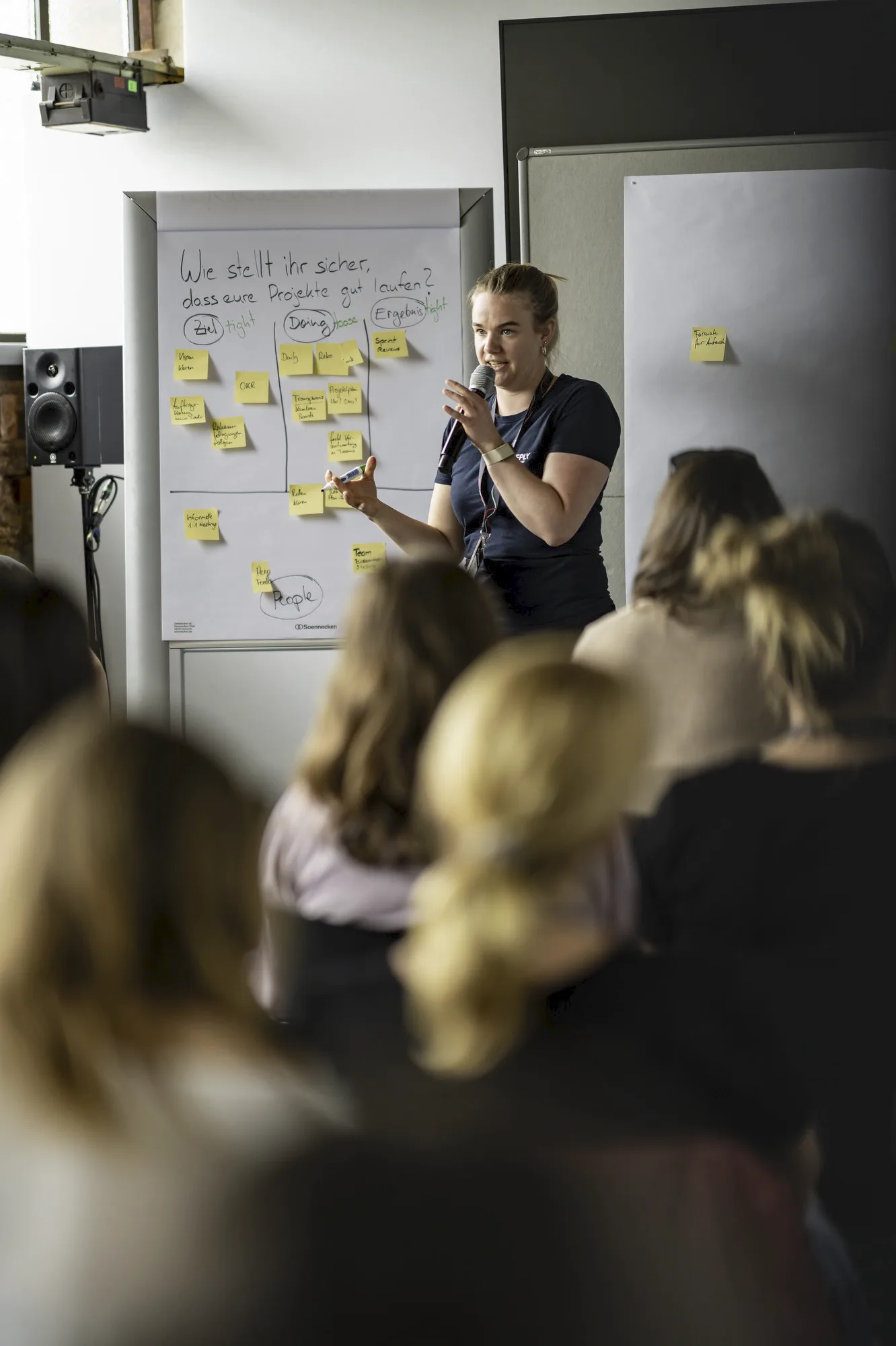
These can be sorted into 4 categories: Goal, Doing, Outcome, People
A useful concept is called tight - loose - tight.
tight: Why are we doing this?
How clear is my vision?
How clear are my expectations
How clearly have I communicated this to my team? Have you asked them…?
loose: How to do it
To what extent can my team decide HOW to work together?
To what extent can my team self-organize and make decisions?
How well can I let go and trust?
tight: What have we created?
How are the outcomes?
How much do we compare the results back to the (original) goal and the vision?
How well do I reflect the learnings with my team?
How often do I reflect the ways of working with my team?
How close am I to the team?
How well do I support them, unblock them?
At a very high maturity, we might be able to focus almost entirely on the people.
Example: quarterly project evaluation
Impressions
Further Reading
On tight - loose - tight
On early warning signs of project decline